
Stop Obsessing Over Resume Length: Our Guide That Actually Makes Sense
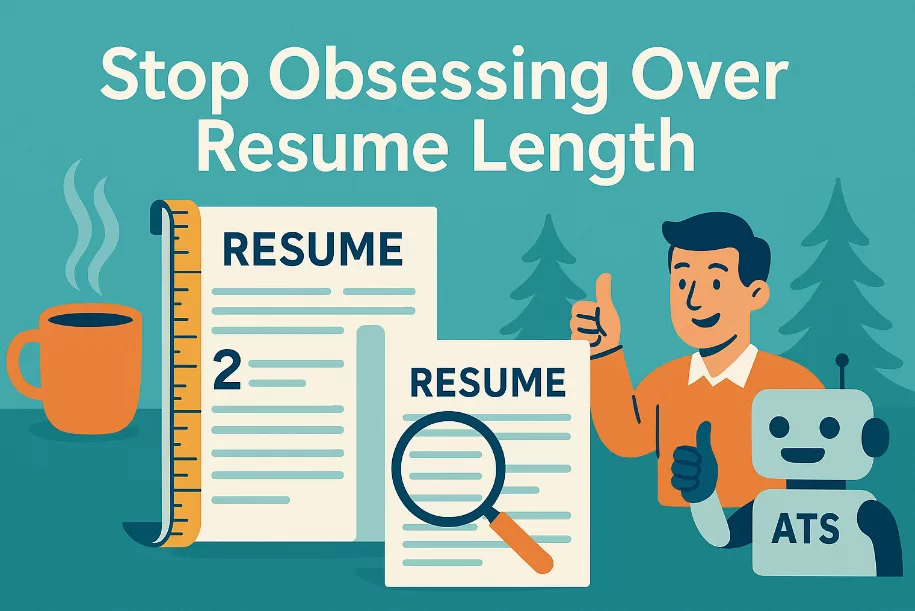
Picture this: It's almost midnight, and you're staring at your resume, trying to squeeze twelve years of career wins into one page by shrinking the font to practically microscopic levels. Sound familiar? If you've been torturing yourself with the "one-page rule," I've got some liberating news for you.
On This Page
Here's the truth that'll save you hours of formatting frustration: Most mid-career professionals actually do better with two pages. That's not just my opinion - 68.3% of HR professionals agree that two pages is the sweet spot for experienced candidates. Meanwhile, only 21.8% are still clinging to the one-page preference.
As one Reddit recruiter put it perfectly: "No recruiter would ever reject a good candidate just because their resume went to two pages. Quality over quantity." So grab that coffee (make it a strong one), and let's figure out exactly how long your resume should be… without the arbitrary rules that make no sense for where you are in your career.
Want a quick gut check on your current resume length?
Schedule a consultationWhat Is the Ideal Resume Length?
The Two-Page Sweet Spot
Let's cut through the noise. If you have 8-15 years of experience, two pages gives you the breathing room you need to actually tell your professional story. You can include those impressive metrics, showcase your progression, and weave in the keywords that'll get you past the ATS robots, all without playing font-size Jenga.
The data backs this up pretty convincingly:
- 57% of recruiters in a 2024 survey prefer two pages
- A LinkedIn poll found that over half of recruiters either have no page preference or are fine with up to three pages
- The old one-page rule? It's becoming about as outdated as fax machines
What This Actually Means for You
Stop earning imaginary points for cramming everything onto one page. You earn interviews by being clear, relevant, and results-focused which usually requires a bit more real estate than one page provides.
In our experience, the moment clients stop obsessing over page count and start focusing on impact, their interview rates improve. It's like finally wearing pants that actually fit instead of squeezing into ones that are two sizes too small.
Sarah's Success Story
I worked with Sarah, a marketing director who'd been torturing herself trying to fit 10 years of experience into one page. She kept deleting her best achievements to make room. We expanded to two pages, brought back those killer metrics, and aligned her keywords with the job descriptions she was targeting. Within three weeks, she had interviews lined up.
Want a quick gut check on your current resume length? We'll give you personalized next steps.
Book a free 15-minute consultHow Far Back Should Your Resume Go?
The 10-15 Year Window
Here's a practical rule that actually makes sense: focus on the last 10-15 years of your career. This isn't arbitrary, it's the timeframe that shows your current skills, relevant tools, and recent impact without diving into outdated technologies or raising unnecessary age concerns.
Think about it: Do you really want to highlight that you were proficient in Windows 95? Probably not.
Industry-Specific Guidelines
- Tech and Fast-Changing Fields: Stick to 5-10 years in detail. Technology moves fast, and you want to showcase current platforms and certifications, not your expertise in defunct programming languages.
- Corporate and Private Sector: Detail the last 10 years, extend to 15 if those earlier roles are highly relevant to your target position.
- Creative Fields: About 10 years on the resume, but you can reference iconic earlier projects. Let your portfolio tell the extended story.
- Leadership Roles: Show your trajectory over 15+ years, but curate carefully. Not every role needs equal real estate.
Federal/Government Resumes Are A Different Beast Entirely: Government resumes follow completely different rules. These comprehensive documents often run 5 pages (or more) and require detailed chronologies, hours per week, supervisor information, and specific duties mapped to specialized experience requirements. If you're applying to government positions, your resume will need to follow USAJOBS guidelines to the letter.
When Older Experience Matters
Sometimes that job from 20 years ago is exactly what makes you perfect for a role. Include it, but summarize rather than detail it. Provide a summary sentence but leave off the bullets to establish credibility without eating up precious space.
ATS Resume Formatting That Actually Works
The Good News About ATS and Length
Here's something that might surprise you: ATS systems aren't rejecting you because of page count. They're tripping up on confusing structure, missing keywords, and fancy formatting that breaks their parsing abilities.
What Actually Affects Your ATS Score
Structure beats brevity every time. A well-organized two-page resume with clear headings and relevant keywords will outperform a cramped one-page version that's hard to parse.
Your ATS-Friendly Formatting Checklist
- Use standard section headings (Work Experience, Education, Skills)
- Stick to a single-column layout
- Choose readable fonts (11-12 point, nothing fancy)
- Skip the graphics, text boxes, and creative flourishes
- Mirror keywords from job postings where they actually apply
- Give your content room to breathe with proper white space
The goal isn't to trick the ATS, it's to make your resume easy for both robots and humans to understand quickly.
One Page or Two: When to Choose Which
When One Page Makes Sense
- You're early career with under 8 years of experience
- You have limited roles to showcase (internships, one or two positions)
- The job is very specific and you can match requirements without extra context
When Two Pages Work Better
- You're mid-career with substantial achievements to showcase
- You need space for quantified results, cross-functional projects, and technical skills
- You're career transitioning and need to explain transferable skills
- You have leadership experience that requires context to understand scope
The Page One Rule: Whether you go with one page or two, page one needs to hook the reader! If your first page doesn't make someone want to keep reading, page two won't save you. Lead with your strongest, most relevant content.
Resume Length Myths vs. Reality
Let's bust the three biggest myths that might be sabotaging your job search:
Myth: "Resumes must be one page, period"
Reality: This rule made sense back when we printed resumes on actual paper and handed them to hiring managers in person - it fit in a file folder and didn't require stapling. But we live in a digital world now, recruiters and hiring managers read resumes on screens where scrolling down takes zero effort. Meanwhile, career paths have become more complex than the linear, 30-year journeys our parents had. Recruiter surveys consistently show that most actually prefer two pages for experienced candidates because it gives a clearer picture of what you bring to the table.
Myth: "ATS systems automatically reject anything over one page"
Reality: ATS systems care about structure and keywords, not page count. A well-organized two-page resume with relevant keywords will outperform a cramped one-page version every single time.
Myth: "Shorter is always better"
Reality: Over-editing often removes the quantified achievements and industry keywords that actually get you interviews. Sometimes you need space to tell your story properly, and that's perfectly fine.
Action Plan: Edit Your Resume to the Right Length
- Set Your Length Target
- Early career (under 8 years): Aim for one page
- Mid-career (8-15 years): Plan for two pages
- Federal/academic: Follow field-specific norms (often longer)
- Curate Your History Strategically
Focus on the last 10-15 years in detail, with older roles summarized if relevant. Think of it like editing a movie - every scene needs to advance the plot.
- Transform Duties Into Impact
This is where the magic happens. Instead of listing what you did, show what you achieved:
Before: "Managed customer service team"
After: "Led 8-person customer service team, reducing response time by 40% and increasing satisfaction scores from 3.2 to 4.6"When you write to outcomes instead of tasks, length decisions become much clearer. Relevance becomes your North Star.
- Make It Scannable for Humans and Robots
- Use consistent formatting and clear headings
- Include keywords from target job postings naturally
- Ensure 11-12 point font with adequate white space
- Lead with Your Best Content
The top half of page one should tell your story at a glance:
- A strong Key Qualifications section or Professional Summary that aligns with job requirements
- Job titles that are clearly related to the target
- Your most recent position with high-impact metrics
- Run These Final Checks
- Skim test: Can someone understand your value in 10 seconds?
- Keyword test: Are the most important skills from job postings represented naturally?
- Relevance test: Does everything included support your target role?
- Length test: Are you hitting the right page count for your experience level?
- Create a Base Resume File
Keep a comprehensive version with all your achievements and stories. Then create targeted versions for each application. This approach keeps you agile without losing your best content.
A Success Story: When Structure Beats Length Obsession
A great example is Colin, an operations manager who came to us with a serious lack of interviews. When I looked at his resume, I could immediately see what was happening. He was trying to cram 12 years of solid experience onto one page, and it showed. His bullets were generic and vague because he'd cut out all the context to save space.
Instead of shortening his resume, we worked together to expand those cramped bullet points. We added the context that showed his real impact (team sizes, budget numbers, process improvements with actual metrics). We wove in keywords from his target job postings naturally throughout his expanded descriptions.
The result? Consistent interviews. We gave his experience and skills room to breathe and made sure both humans and ATS systems could quickly understand the value he brought to the table.
Key Takeaways
- For mid-career professionals, two pages is typically ideal - recruiter surveys consistently show preference for this length over cramped one-page versions
- Focus on the last 10-15 years of experience in detail, with older roles summarized only if they add relevant value
- ATS performance depends on structure and keywords, not page count. Clean organization beats arbitrary length limits every time
- Quality content beats length restrictions. Better to have two strong pages than one overcrowded page that's hard to read
- Page one must hook the reader whether you choose one page or two. Lead with your most compelling, relevant achievements
The bottom line? Stop torturing yourself over page count and start focusing on telling your professional story clearly and compellingly. Your future hiring manager will thank you for it.